If I were made dictator of the universe for a minute or two I'd like to change some aspects of conservatory training. These would be the additions/changes:
One semester (at least) of music writing and improvising. NOT taught by a "composer", especially not by an academic one. Here the goal is to reveal to musicians that if they can play an instrument they can improvise on that instrument. And also they can write music of very diverse styles for that instrument of any other.
One semester of "pop music" performance. Here we would, for example, play Let It Be. But the pianists would be given the chart on a cocktail napkin and NOT (I repeat NOT) permitted to write out any parts. The performance would have to be convincing, etc. Real world.
Basics of recording, multi-tracking, etc. Are there any musicians, anywhere, who at this point don't need recordings of their playing? Might as well be armed with some knowledge of how it's done...maybe even enough knowledge to do it one's self.
I would certainly toy with the idea of getting rid of music history. Maybe a course that contains the basic bullet points. Maybe in theory situate the concepts historically. There seem to be lots of musicians in the world who function just fine without knowing thing one about clausulae -- just as there are millions of musicians worldwide who know nothing of set theory and would much prefer to stab themselves repeatedly with rusty implements than learn anything about said subject.
Showing posts with label commentary. Show all posts
Showing posts with label commentary. Show all posts
Sunday, January 2, 2011

Thursday, December 30, 2010
the yearly roundup
Hard to believe but another year is looming large on the horizon. That means it's time for the yearly roundup of good stuff that I've encountered music-wise. And by encountered I also mean re-encountered, too. This stuff isn't necessarily particular to 2010, that's just when it happened my way.
Books
David Toop's Sinister Resonance. Toop does it again. This book is special for me because it has come along right at a time when I've been thinking about the peripheries of music and sound more generally as well as what's going on when we hear/perceive such.
Wallace Berry's Structural Functions in Music. Actually I'm not sure where I come down with this book. The author does penetrate deeply. I'd be interested if the book were about music and not just a small segment -- though maybe people could start writing appendices of sorts applying Berry to Indian music, R&B and free jazz, etc.
Recordings
Carolyn Hove, Ascending to Superlatives (yeah, I'm not thrilled about the title, either, but there it is...) Great English horn album starting off with a Castelnuovo-Tedesco piece entitled Eclogues (for English horn, flute and guitar) which is fantastic. All the works are terrific. This record will make you believe in 20th century music (if your faith has indeed ebbed). Also, though I went to CCM I had no idea the Gerhard Samuel was also a composer...
Not entirely unrelated is L'ensemble Pyramide's recording of Migot chamber works featuring flute, clarinet, harp, bassoon, etc. Great pieces! I'm a huge Migot fan and if you've never heard of him just go ahead and jump in with this one. The works are modal and very, well, French. If you dig on the likes of Poulenc and Dutilleux you'll like this one. There's a wikipedia thang about Migot here.
Gentle Giant's Octopus. My favorite prog album to date. Very diverse, excellent tunes.
Bill Emerson's Gold Plated Banjo. A good friend of mine always turns me onto what he considers the "best of", any genre. For bluegrass his pick is this one, and I have to agree. It's so filled with gladness that it'll make you happy that you're alive -- it'll at least put a big smile on your face!
The B-52s first album. I heard it when I was in 6th grade and loved it. I listened to it again about a month and a half ago and I still love it.
Other albums heard a long time ago and re-enjoyed: Vangelis' Albedo 0.39. That's right albedo, the reflectivity of an object, 1.00 being perfect, 0.39 being roughly the Earth's. V does all of the instruments and the tune Main Sequence is spot-on fusion (with even a great little blues lick near the end!). Of course the opening tune is great (Pulstar) as is the tune Alpha, both of which were in Carl Sagan's Cosmos.
Susanne Schoeppe's Ponce, Moreno, Dolezel & Castillo: Guitar Recital (yeah, technically any recording with the word "recital" in the title should entitle the maker(s) to a public torturing...pretend the album is called Diario, I guess). Susanne needs to be thanked, sincerely, for playing (and playing beautifully) Torroba's Sonata Fantasia. It's an absolutely exquisite work and hopefully will only grow in popularity.
Zombies: Odessey and Oracle.
Video
Scott Henderson: Jazz-Rock Mastery. This is really 2 videos in one: the first is about scale choices for given common chords (maj7, min7, min7b5, dom7 and altered dom7s -- Scott details playing both inside and outside); the second concerns phrasing and is really a breath of fresh air.
Various
The You Rock Guitar. I picked one up back at the beginning of November. A really fabulous midi controller. FINALLY a midi controller that has what I (we) really want: a midi out! No need for a 13 pin cable which then gets converted to midi then sent to the midi out. This is very inexpensive and easy to play. It's not a guitar, so there are some compromises: pulling off to open strings doesn't work, and the strings which are picked/plucked are all the same size which means that your hand doesn't get any clues as to where it is by string size. It has some onboard sounds but I go right into a Yamaha TX-7. The best feature: it doesn't EVER go out of tune...
Thursday, April 29, 2010
overtone singing
What is overtone singing? If you've ever heard Tibetan Buddhist chant you'll know. But here's a short, helpful tutorial.
Basically the tongue (and lips and so on) in this type of singing changes the overtones that are produced while on a constant fundamental pitch producing a "bagpipe" type sound -- i.e. a high changing melody over a low drone. For some examples on Amazing Grace:
http://www.youtube.com/watch?v=mO4Uh-Mini4&feature=related
http://www.youtube.com/watch?v=NgyJ547oA4I&feature=related
http://www.youtube.com/watch?v=kFWYSW4vfcA&feature=fvw
This ties in to the post on subtractive synthesis, and makes clear that there's a lot more going on when one pitch is sounded than one commonly thinks.
Tuesday, April 27, 2010
tab snobs
I know that there are many, many guitarists out there who are "tab snobs", i.e. completely against the idea of communicating a music score in any other form than in familiar music notation. There are of course many, many, many more guitarists who can't read music or know where any notes are located on their instrument. So the tab snobs' position is somewhat understandable. But historically they're on the shakiest of ground, because if we go back and look at lute music from the 16th and 17th centuries it was only written in... (drum roll please) ...tablature. For the briefest of introductions check this site out. Also the Frederick Noad anthologies of Renaissance and Baroque music have some info regarding this, plus of course the Harvard Dictionary of Music, etc.
The reason that tab is useful is that it locates exactly where notes are to be played. In classical guitar scores this is settled by using a lot of extra information: fingerings, strings, positions, etc, which in a sense amounts to a tablature overlay on the score. I think that only offering up the notes without any indication of position and so on is lazy, unless we're only concerned about analyzing the notes and not playing them.
The reason that tab is useful is that it locates exactly where notes are to be played. In classical guitar scores this is settled by using a lot of extra information: fingerings, strings, positions, etc, which in a sense amounts to a tablature overlay on the score. I think that only offering up the notes without any indication of position and so on is lazy, unless we're only concerned about analyzing the notes and not playing them.
Thursday, April 15, 2010
subtractive synthesis
A million years ago when I was very young I heard Wendy (but at that point in time Walter) Carlos' Switched On Bach. I think that it was the last movement of the 3rd Brandenburg Concerto that made my jaw drop and just sucked me into that world -- I desperately wanted a huge synthesizer that filled up rooms with equipment.
I only new the name of the synthesizer: Moog. I had no concept of "subtractive" or "analog" and so on. The first synth I ever got (much later) was the Roland Alpha Juno-2. Technically it's subtractive (it has digital oscillators and filters, etc, but has an analog sound). The only thing that made that hard was (1) there were no knobs -- all of the controls were buried inside and accessible only one parameter at a time; (2) I had no idea how synthesizers worked and consequently only made use of the presets occasionally making some modifications.
The thing is subtractive synthesis isn't hard to understand at all. And grasping it really makes it easier to understand what might happen when you start tweaking the parameters. (By the way this is absolutely not true of other types of synthesis like FM -- frequency modulation -- found on the Yamaha DX-7.) And these days software synths are cheap and easily available.
So what is subtractive synthesis? Here's my terse and possibly awkward definition: taking a basic sound (waveform) and filtering (i.e. subtracting out certain harmonics from) it to give a new (desired) sound. And if you're using a synth (software or otherwise) that's subtractive and want a little more info about it/them google the term and root around. Here are a couple of helpful sites:
DarkSonus
Yala
Wikipedia (this has a nice comparison with the human voice to make the mechanisms more easily understandable -- of course it's wikipedia and could change in a minute)
Here's a diagram I lifted from a KVR wiki which visually clarifies what's happening in this type of synthesis:

Of course in the end it's certainly not necessary to know how a synth works to use it effectively. But that knowledge can help you and aids in conceptualizing how sound works more generally.
Saturday, April 10, 2010
practicing music as entertainment
Mass communication has made the means of delivering and distributing music easier and easier: up to the point where if one were to want to escape the grasp of music in an urban setting the only means of doing so would be earplugs. It is ubiquitous. From radio to tv to all sorts of tape and vinyl formats to cds to mp3s to video games...
But if we go back in time, say, 200 years there wasn't such a machine in place. In fact then the only means of hearing music was to hear it performed live. And live performances are not a great mechanism of mass delivery. What did suffice back in the day for that was sheet music. You could buy a Beethoven sonata or your favorite Schubert lieder or a Rossini overture arranged for solo piano and take it home and play it. Of course this presupposes that one could play, or even that there's a substantial population of "amateur" (I detest the term...more on that later) musicians who would consume the media in question. And there of course seemed to be.
This brings me to my main point: that practicing music is a great form of entertainment. Of course practicing music is often seen as a means to an end: usually a performance-of-some-sort end, and in this sense the term is loaded with laborious overtones. Also the word practice is highly equivocal: it might mean running scales, sight-reading through pieces or actually performing live (because performance needs practice, too). But no matter what you're practicing it should be fun -- though admittedly some things are just more fun than others (that's our world after all).
Globally viewed there's an advantage here, too. Were the world filled with people who practiced/played music at home, even just for themselves, there would be so much more music in the world! And a nice benefit to "professionals" is that there would be a much, much, much more informed audience base. And even if Stockhausen and Ornette Coleman always fetch a microscopically small slice of the population's attention, a fraction of a fraction of a fraction of a percent is still a large number when 6 billion people are under discussion.
Friday, April 9, 2010
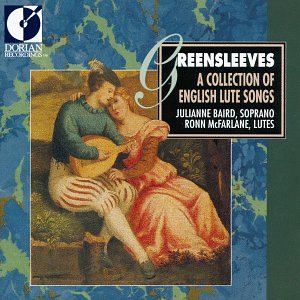
random cd pulling: greensleeves
Soon because of spatial limitations I'm going to box all of my cds, and in an effort to get reacquainted with some of them I've begun shutting my eyes and randomly selecting one from the array. Today's pulling: Greensleeves: A Collection of English Lute Songs. The artists: Julianne Baird, Soprano and Ronn McFarlane, Lutes (both 8 and 10 coursed varieties). This cd, incidently, was nestled between King Crimson's Ladies of the Road and Stanley Jordan's Flying Home -- NOT the best way to organize any collection.

This recording hails from 1989 but I didn't get a hold of it until 1993 (I'm pretty certain of that date because I was working on songs from that repertoire for a recital in school). And this was a cd I didn't really buy: it came via a friend who had some sort of BMG mailing cd arrangement (like get 10 cds for a $1 or something like that). Anyway I dug/dig it. The playing and singing are both done deftly.
My favorite tune is Dowland's "Come Again", though I'm not entirely on board with the handling of the "To see, to hear, to touch..." section. It would've been nice to have Dowland's "Come, Heavy Sleep" but they can't include the entire repertoire, especially when the scope is broad composer wise.
Not all of the pieces are duets: there's a fair number of solo lute works thrown in, and they're played beautifully. As a guitarist I feel that these pieces sit on the guitar well, but it's always nice to hear them on lute: they're "lighter" if you will (they're also higher in pitch unless you correct for that on the guitar with a capo). The anonymous "Bonny Sweet Boy" was a nice surprise: it's a very melancholy piece, and kind of short.
One definite thing worth mentioning -- with a view to bridging what might seem prima facie as disparate styles of music -- is that this kind of Renaissance lute music is highly improvisational. That's not really true of the ricercare of da Milano, for instance, but in these stylized dance pieces it's really the case. I'm thinking particularly of the solo music, but it's also easy to imagine a lute accompanist spontaneously adding passages (or licks if you will) and experimenting to make the music as interesting and beautiful as possible (and not dull and the same every time). If you'd like to see that in action I would certainly recommend as a starter Frederick Noad's Renaissance Guitar book. It has solos, duets and songs. There's also a good book of only solo music by the Japanese Zen-on Guitar Library simply entitle Renaissance Guitar. I'm not so sure it's in print anymore: you can check out the Japanese site here: Zen-On. A used copy shouldn't be too hard to run down I'd think.
This recording hails from 1989 but I didn't get a hold of it until 1993 (I'm pretty certain of that date because I was working on songs from that repertoire for a recital in school). And this was a cd I didn't really buy: it came via a friend who had some sort of BMG mailing cd arrangement (like get 10 cds for a $1 or something like that). Anyway I dug/dig it. The playing and singing are both done deftly.
My favorite tune is Dowland's "Come Again", though I'm not entirely on board with the handling of the "To see, to hear, to touch..." section. It would've been nice to have Dowland's "Come, Heavy Sleep" but they can't include the entire repertoire, especially when the scope is broad composer wise.
Not all of the pieces are duets: there's a fair number of solo lute works thrown in, and they're played beautifully. As a guitarist I feel that these pieces sit on the guitar well, but it's always nice to hear them on lute: they're "lighter" if you will (they're also higher in pitch unless you correct for that on the guitar with a capo). The anonymous "Bonny Sweet Boy" was a nice surprise: it's a very melancholy piece, and kind of short.
One definite thing worth mentioning -- with a view to bridging what might seem prima facie as disparate styles of music -- is that this kind of Renaissance lute music is highly improvisational. That's not really true of the ricercare of da Milano, for instance, but in these stylized dance pieces it's really the case. I'm thinking particularly of the solo music, but it's also easy to imagine a lute accompanist spontaneously adding passages (or licks if you will) and experimenting to make the music as interesting and beautiful as possible (and not dull and the same every time). If you'd like to see that in action I would certainly recommend as a starter Frederick Noad's Renaissance Guitar book. It has solos, duets and songs. There's also a good book of only solo music by the Japanese Zen-on Guitar Library simply entitle Renaissance Guitar. I'm not so sure it's in print anymore: you can check out the Japanese site here: Zen-On. A used copy shouldn't be too hard to run down I'd think.
Saturday, April 3, 2010
stage shows
So I happened to see a band the other night (they took to the stage after the band I came to see played). They were really good: all of them had command of their instruments/voices, their songs were highly emotive and interesting and so on.
Buuuuuuut I had one issue, a pet peeve of mine, because I've been involved in these situations, namely please make a set list before you go on stage! I guess the idea behind no set list is to give off a vibe of "we're really laid back," and "we're so good that whatever we decide to play will work," etc. And several years ago I saw Chick Corea's Electric Band and he seemed to have that approach. And, hey, if you're at Chick's level you can make this approach work (though Chick was almost a comedian in between songs which added to the show and made his laisez-faire approach to the next tune really work).
The issue is most people really aren't there. So if you don't have legions of fans worldwide I'd give this advice: make a set list. It has 2 main beneficial side effects:
1. The set you're playing will stand a better chance of having some well-defined, good shape. Calling out the tunes you want to play next can yield good tunes, but all minor key, sad songs might get bunched up where you don't want them. Also it's a good idea to consider the energy that needs to be projected at the opening and closing of sets.
2. The performance should be a performance and not a rehearsal on stage in front of people. Others may not be so bothered by this, but I find it highly annoying to have to hear the discussions of what song would be good to do next, etc.
There's another possible benefit, too. The band I saw the other night attempted a cover and failed, started over, and stopped again. They proclaimed, "We didn't write this," though they did have a chart for the tune in front of them. It seems that a set list might concretize the fact that all the tunes need to be at a performable level.
OK, point made...
Tuesday, March 23, 2010
vocaloid
I'm usually behind in tech stuff: not because I don't dig on it hard but because I'm not young enough to just know when this stuff comes out exactly the minute it does. A student of mine turned me onto this product (ultimately from Yamaha): the ZEROGcs Vocaloid. On their page you can listen to demos and download the free version 1 (which is quite limited but still quite cool).
Basically this is a synthesizer voice: in a piano-roll type scroll you type in the notes and the lyrics. It strikes me that the uses here are many, many, many. If nothing else it's fun to listen to the tunes that others have done with this...
Basically this is a synthesizer voice: in a piano-roll type scroll you type in the notes and the lyrics. It strikes me that the uses here are many, many, many. If nothing else it's fun to listen to the tunes that others have done with this...
Sunday, March 21, 2010
brainwave entrainment
The idea behind brain wave entrainment is that certain brain wave states can be induced by external stimuli, viz. by a series of tones and blinking lights. Why one might desire such a feat is that certain states of the brain are associated with certain brain waves (as measured by EEG or electroencephalography, "electro-brain-writing"). For example delta waves (1-4 Hz) are associated with deep sleep, alpha waves (7-12 Hz) with relaxed, meditative states. The latter are obviously something that would be nice to have access to whenever, thus 'mind machines' come into play.

Here's a virtual one, the MetaMindMachine. Download it, unzip it and run it. On my computer it begins with some annoying pops, but it settles into tones after a bit. It's way too early for me to say if it's producing it's desired effect or not (I've tried to make my own in the past but to no avail), but it's definitely fun and experimenting with it seems very worthwhile.
Here's an interesting and related-to-music-peripherally point: brain waves can be induced by tones in the ears that are of different frequencies. For example, if alpha waves are desired (say a 10 Hz wave) then in one ear a pitch of 440 Hz is sounded while in the other ear a pitch of 450 Hz or 430 Hz is sounded. The difference in pitch is the wavelength produced in the brain (in this case 10 Hz).
Oh, this is an open-source program, so if you're able and inclined you can customize it, improve it, etc (I'm not among that flock).
Sunday, March 14, 2010
overtones and the major scale and a question
In his Theory Of Harmony Arnold Schoenberg gives a rationale for the major scale based upon the overtone series. It goes something like this. The easiest to discern different overtones (or harmonics) are the octave, the perfect fifth and the major 3rd. If you consider a C major scale, the C will produce a G and an E. The G, if considered as a fundamental tone, will produce a D and a B. He then backs up and considers that C is an overtone of F: F produces C and A. A bit more graphically this looks so:
Then, omitting repetitions and reordering one has all the tones of the C major scale: c, d, e, f, g, a, b.
You hear this often: that the overtone series is responsible for the tones of the major scale (or at least implies a major scale collection of tones). But it's really, really, really hard for me to imagine what the process was that brought the major scale into being from the overtones. It's easy to imagine people 10,000 years ago singing and playing instruments. It's difficult to imagine that they had an idea of the overtone series, and that it was somehow responsible for the music that they were making. (It's actually much easier to imagine a scale being built out of successive perfect 5ths: f, c, g, d, a, e, b. In fact the first five tones of this series can account for the major pentatonic scale: f, g, a, c, d.)
But then here is the question: how did the tones of scales develop? Was the first vocal music only made out of perfect fifths and octaves? Without ever hearing the music of our earliest ancestors we won't ever be able to analyze or theorize too much (except upon shaky ground). But it is worth pondering...
G (D, B)
C (G, E)
F (C, A)
C (G, E)
F (C, A)
Then, omitting repetitions and reordering one has all the tones of the C major scale: c, d, e, f, g, a, b.
You hear this often: that the overtone series is responsible for the tones of the major scale (or at least implies a major scale collection of tones). But it's really, really, really hard for me to imagine what the process was that brought the major scale into being from the overtones. It's easy to imagine people 10,000 years ago singing and playing instruments. It's difficult to imagine that they had an idea of the overtone series, and that it was somehow responsible for the music that they were making. (It's actually much easier to imagine a scale being built out of successive perfect 5ths: f, c, g, d, a, e, b. In fact the first five tones of this series can account for the major pentatonic scale: f, g, a, c, d.)
But then here is the question: how did the tones of scales develop? Was the first vocal music only made out of perfect fifths and octaves? Without ever hearing the music of our earliest ancestors we won't ever be able to analyze or theorize too much (except upon shaky ground). But it is worth pondering...
Saturday, March 13, 2010
sampling + hip hop + on the media
WNYC's On The Media did a whole show (actually a rebroadcast) about the future of the music industry this week, one segment of which -- entitled "They Say I Stole This" -- focused-in on sampling. (Sampling parts of tunes, that is, as opposed to sampling an instrument for use in your midi setup.) You can download the podcast (from iTunes, etc) or read the transcript here. It's an interesting piece concerning copyright and fair use, and though a little thin it does provoke some thought.
I think everyone at heart would say that stealing music isn't a good thing (especially if you're a musician and you'd like to see some bread for the work you've done), but on the other hand if you're old enough to have ever made cassette tapes of your favorite songs it just doesn't seem like copying music digitally should be such a big deal, though the implications are a little different. And if copying whole tunes doesn't seem like such a big deal certainly copying little parts of them won't seem a big deal, either. In fact a decent artistic manifesto could easily be written concerning the merits of using only or primarily the detritus of all the music that has come to us from the past. And not only of famous tunes: there is so much recorded music that has come and gone (and not even digitized) -- and was at best only marginally popular -- that using it to create new music seems like a beautiful way of preserving it, and acknowledging that we are indebted to our past, all of the past.
I think everyone at heart would say that stealing music isn't a good thing (especially if you're a musician and you'd like to see some bread for the work you've done), but on the other hand if you're old enough to have ever made cassette tapes of your favorite songs it just doesn't seem like copying music digitally should be such a big deal, though the implications are a little different. And if copying whole tunes doesn't seem like such a big deal certainly copying little parts of them won't seem a big deal, either. In fact a decent artistic manifesto could easily be written concerning the merits of using only or primarily the detritus of all the music that has come to us from the past. And not only of famous tunes: there is so much recorded music that has come and gone (and not even digitized) -- and was at best only marginally popular -- that using it to create new music seems like a beautiful way of preserving it, and acknowledging that we are indebted to our past, all of the past.
Friday, March 12, 2010
sci-fi sound sculpture
Sound sculptures are interesting to me. Actually they seem more interesting in the abstract (i.e. talking about them) than actually interacting with most of them, except for the best example, viz. wind chimes. In that spirit here is a completely conceptual (for now) sound sculpture...

I imagine the following: deep in some woods (perhaps even a rain forest) we encounter plants that produce soap bubbles, just like you see little kids (and not so little) blowing all the time. There's only one difference: when these bubbles burst a sound is produced. A sine wave most likely. The frequency is dependent upon how large the bubble is when it bursts (bigger = lower tones). Also, more complicated sounds are produced when these bubbles combine. The sounds could become much like those found on the Casio CZ-101 (which combined sine waves...I believe they called it Phase Distortion synthesis).

I imagine the following: deep in some woods (perhaps even a rain forest) we encounter plants that produce soap bubbles, just like you see little kids (and not so little) blowing all the time. There's only one difference: when these bubbles burst a sound is produced. A sine wave most likely. The frequency is dependent upon how large the bubble is when it bursts (bigger = lower tones). Also, more complicated sounds are produced when these bubbles combine. The sounds could become much like those found on the Casio CZ-101 (which combined sine waves...I believe they called it Phase Distortion synthesis).
Monday, March 8, 2010
music education
The trumpet was my first instrument and I enjoyed it. But once I started playing guitar the trumpet took a back seat. And by the time I went to high school I decided not to continue to play trumpet in the band. I recounted this experience to someone the other day who asked "Why did you quit?" Assuming that it was because I wasn't any good. I was mediocre, and certainly not so passionate about it. It was hard for playing trumpet in the band to compete with learning rock and blues on the electric guitar. Not only because the latter is more socially 'relevant' (i.e. more people go out to clubs and buy music on cd, etc that is rock/blues than is marching band) but also because it's more fun and creative to me -- or at least works more actively a different part of the creative musical brain.
To me this is an oversight of music educators in schools. I know that there are places where improvisation is taught, but it strikes me that overall learning music in school presents only the tiniest slice of what music is. Why no rock band classes instead of just marching band and orchestra? I do teach one class in an elementary school (an afterschool, no grade situation) where, in addition to learning to read music we really do focus on trying to learn songs. Let's face it: popular music culture is not music-score driven, so the need to teach people to read music is less (there, I said it). Just like in 'real life' songs have to be learned by hook or crook: by ear, by tab, by watching someone play.
It's really a shame that this isn't done: teaching AC/DC's Back in Black, Deep Purple's Smoke on the Water, and so on, would definitely bring a lot more people into the fold of music.
Monday, March 1, 2010
mixing music + $$$
Look, I'm basically very distrustful of people who only play music when money is involved -- it strikes me that there is a decided lack of passion in such instances. And art after all is about passion (according to me, anyway). But those people have a point: not only should they be allowed to make a living (this is a largely a capitalist system, after all) but also there is a huge tendency in our culture to expect things like music to be free. Always expecting money, then, will help counterbalance this tendency.
It's amazing how often I meet doctors, lawyers, architects, business people who feel that any lesson or fee for doing a gig which isn't free is really overpriced. They don't, notice, think that the services that they offer should be free. Again, this isn't totally unfair: we don't live in a society where economic worth is determined from some governmental agency and handed down to us: we bargain, each party attempting to get the best possible deal for itself. The pernicious aspect is, again, the expectation that music (art in general) should be free. I suppose because it should, after all, be 'fun'.
I don't argue with that last point. In fact I think that equally pernicious for art (especially 'serious' music -- serious said with rolling eyes) is the lack of awareness that art has an entertainment component. Nevertheless if people expect there to be music there have to be musicians making that music. And if they expect that music to soar as high as is possible it will have to be done based upon the model of doctors: we don't expect surgeons to be hobbyists. Music is not so life and death, obviously, but the principle is the same. There have to be some full timers out there practicing their craft if we have high expectations. And not only that, those who labor (and it is work) after a day gig -- effectively a second job -- also should of course be rewarded economically. If you consider all the time, money for lessons, money for instruments and rehearsal spaces, and outlay for advertising it's really rare that there's a real economic profit.
Friday, February 26, 2010
let's make a deal...
OK, so your band gets its first gig. You tell all your friends and hopefully get a lot of bodies to show up when you play. But here's the thing: what if you want to keep your performing chops up and you want to go out every week and play? All those friends who showed up to your first gig may not (probably won't) show up at every gig if the frequency is weekly or bi-weekly. Maybe monthly. Maybe.
Whether you're "good" or not has no bearing on a club's interest in you. If you can bring people through the door then you count. You'll be asked back, etc.
That's fair, I do suppose. Consider the following: a great band (let's just stipulate that it's great, however you would measure it) shows up to a club with absolutely NO audience. A mediocre band shows up and brings in some people. The first band just seems lazy. Honestly, if they're not interested or if they're simply incapable of bringing a crowd then why should anyone else care to do so for them? It's not an irrational position.
Having said that, however, it does seem that the same standard should apply to clubs themselves. They obviously have more leverage, but the principle is the same: if they're not interested in promoting themselves all the time why should anyone else do it? It seems that certain clubs (not all) have simply shirked their responsibility upon the bands that they "hire". These are the venues that are going to be empty if no band shows up. Again, why would anyone want to help them do what they don't want to do?
So I say let's make a deal: both parties involved should really, really make a commitment to bringing in the most people possible. Bands then get to play in front of people and clubs get to sell more drinks, food, whatever. Totally win-win.
Subscribe to:
Posts (Atom)